The arduous path of Sámi artists towards recognition
I fell in awe and love with Britta Marakatt-Labba’s work shortly after I moved to Tromsø in northern Norway in 2015. I did not know who Marakatt-Labba, a Sámi textile artist, was back then, but as I walked through a public room connecting two buildings at the University of Tromsø, I noticed an artwork stretching all along the curved walls, at eye level. It was entitled Historja (2003-2007), meaning both “history” and “story.”

Photo: Marja Helander, Britta Marakatt-Labba. Portrait of Honour 2022, Swedish National Portrait Gallery.
Intrigued, I approached the work and started to look at it closely, moving from right to left together with the intricate tiny embroidered figures that populated this magic story: the birch trees in whose branches hid small heads clad in Sámi hats – the goddesses of Sámi mythology – the fox that becomes a brown bear that morphs into a wolf, and then moose, wolverines, lynx, rabbits, dogs, and groups of Sámi people in their gákti, moving seamlessly across the landscape on skis. And ahead of them, packs of reindeer, brown, white, and black, their horns delicately shaped by a few stitches of grey and black fabric.
All along, I had been holding my breath, enthralled by the embroidery's evocative power. Further along the 24-metre-long textile piece, I was stunned and close to tears by the 2D depiction of the corral where reindeer are gathered in a circle, with a few reindeer herders launching their red lassos at the animals. How could the artist capture so much movement, as well as the solemnity and hard work of the siida, with just a few threads of dyed cotton on linen?
Depicting life, thread by thread
Later, when I was able to see more of Marakatt-Labba’s works at the Northern Norwegian Art Museum in Tromsø, I would again find the artist’s incredible capacity to create dramatic tension and to evoke the vitality of both human and non-human beings, notably in The Crows (1981). That embroidered piece depicts a group of Sámi protesters opposing the damming of the Alta River, as they are being descended upon by Norwegian police, represented as crows gradually taking human form. The dark uniforms of the police and their bulky gaits contrast with the bright, beautiful Sámi regalia, as the small figures huddle together until they are forcibly removed from the protest site. Marakatt-Labba was part of these protests in the early 1980s, and said she created the work quickly after.
In addition to the aliveness of her works, another thing that fascinated me was the layers that compose the pieces. Layers in terms of texture, with the thick coats of humans and animals, the thin outlines of mountains, the appliqués that trace the sky or sea in one stroke of blue; but also, the layers of meaning: political, spiritual, mundane, and transcendental. She depicts the Sámi people fishing,

Britta Marakatt-Labba, Vintergatan, 2022. Stortingets kunstsamling. Foto: Hans-Olof Utsi/Galleri Helle Knudsen © Britta Marakatt-Labba
A circular understanding of the world
The climate crisis and the Scandinavian governments’ exploitative use of land in traditional Sámi territories are recurring themes in Marakatt-Labba’s recent embroidery works. Her closeness to nature and her understanding of the world as circular and inter-relational are at the heart of her practice. Animals, humans, plants, and the cosmos are all mutually reliant and interconnected in the stories she stitches.
The slow rise in the recognition of fibre art
Despite the often-vivacious scenes she depicts, slowness is also at the core of the artist’s practice. That has to do with the nature of her art: embroidery takes time and patience, cannot be edited like audio or video work, and the level of detail invites the viewer to slow down and take it all in. The arduous nature of embroidery and its prior association with “feminine” crafts made it an unpopular choice for major art museums for most of the modern museological period. Female artists working with textiles and embroidery – such as the now world-famous Anni Albers (1899-1994), Faith Ringgold (1930-2024), or Sheila Hicks (b. 1934) – faced an uphill battle and much gender discrimination when trying to exhibit their works and be recognised as artists. The relentless work of both the feminist and fibre art movements in the 1960s/70s sparked a shift in awareness, and the Lausanne Biennale in 1962 was one of the first major events to place textiles on the contemporary art map.
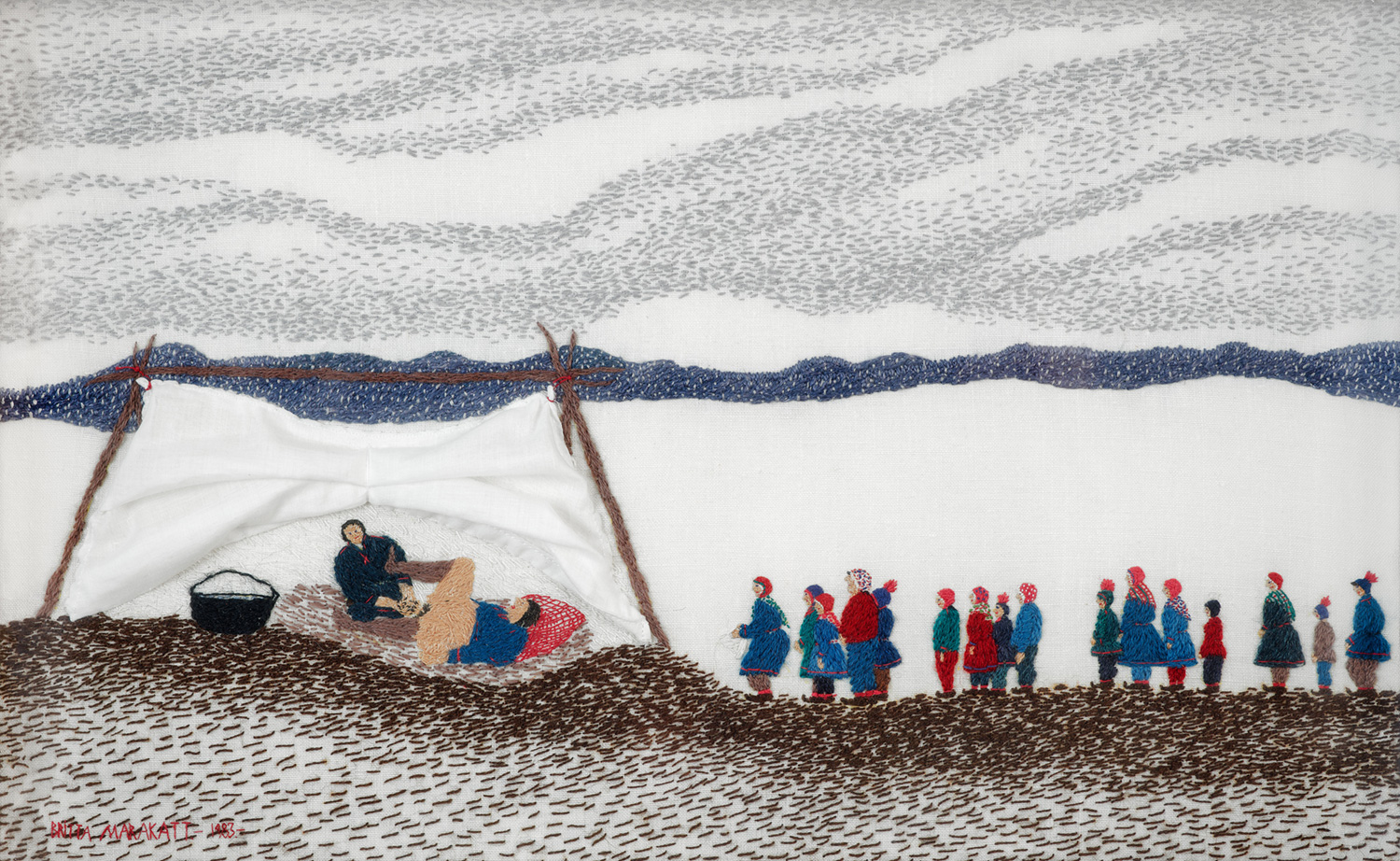
Likewise, Sámi artists were largely ignored or were curated into the “crafts” category for most of the 20th century. The fact that the Moderna Museet, in Marakatt-Labba’s native Sweden, held its first major exhibition entirely dedicated to a Sámi artist in 2025 is telling. In fact, Moderna had not acquired any of Marakatt-Labba’s pieces until 2019, when, by that time, she had been active as an artist for almost 40 years.
Similarly, in Norway, most museums in Oslo and northern Norway did not showcase any major Sámi exhibitions until after the turn of the year 2000. The exhibitions that did take place before that, in the 1970s and 1980s, were the result of the hard work of Sámi artists themselves.
Sámi torchbearers: from underground pioneers to worldwide fame
Marakatt-Labba herself co-founded, together with Synnøve Persen, the artist group known as Mázejoavku, named after Máze, a village in Finnmark where some activist-artists were living. In 1978, they organised an exhibition at Galleri Alana in Oslo, where their works featured alongside other group members such as Aage Gaup and Hans-Ragnar Mathisen, known for his maps of Sápmi. This was a pivotal moment in art history. Another important but lesser-known contribution to the rising awareness around Indigenous artists in Scandinavia came from Sámi artists Ingunn Utsi
There were other notable exhibitions of Sámi art throughout the early 2000s and 2010s,

Detail from Historjá, Britta Marakatt-Labba. Photo: Nasjonalmuseet for kunst, arkitektur og design/The National Museum of ARt, Architecture and Design. KORO
Since then, the demand for Sámi artists and art has grown exponentially. Máret Ánne Sara, who is also the cofounder of the influential artist group Dáiddadállu, based in Guovdageaidnu, had her first major solo commission outside Scandinavia last year at Tate Modern, highlighting the rapid rise of Sámi artists, who have been active for decades, into the international art scene. Many cultural institutions across Europe have had to reckon with increased scrutiny of their white-male-dominated collections. Not that this is really news or that no one had pointed it out before. The Guerrilla Girls wrote their Manifesto almost 38 years ago, which stated: “Less than 5% of the artists in the modern art sections are women, but 85% of the nudes are female.”
Sámi artists, as discussed earlier, have also fought since the 1970s to have their works included in national exhibitions and collections. But it took 5 decades for things to start changing. That is good news in the sense that Sámi artists are getting recognised; however, it also often comes with its own pitfalls: lack of involvement of Sámi curators, partial knowledge of the history and cultural context, as well as lack of deeper reflections around how to reshape traditional museology to reflect the many-faceted aspects of duodji, for example.
The exhibitions to look out for this year
In Helsinki and Tallinn, two high-profile shows centred around Sámi art are coming up this year. We Who Remain will open at Kiasma Helsinki at the end of March 2026, in collaboration with the Sámi Museum Siida, introducing a medley of more than 20 Sámi artists, with works created between the 1970s and the present. It does not come as a surprise that some of Britta Marakatt-Labba’s works will be on display in this exhibition curated by Sámi activist Petra Laiti.
After last year’s exhibition They Began to Talk (2025), focusing on voices from the Arctic region, KUMU will unveil no beginning, no end: Decolonial Gestures in Sámi Worldbuilding, on 11 September 2026, in a show that promises to encompass both art and the political struggles the Sámi people have been dealing with for the past decades. The exhibition draws on a three-year research project initiated by Linda Kaljundi, titled Expedition-Estonians and Indigeneity, which aims to participate in the decolonisation of Eastern European and Eurasian cultural heritage. The exhibition no beginning, no end is built around the idea of Indigenous Sámi worldbuilding and Indigenous justice, as well as the continued colonial violence against Sámi people at the hands of Scandinavian countries.
When I asked curator Ann Mirjam Vaikla to tell me more about the exhibition’s genesis, she traced Kumu’s decolonial agenda back to the preparations for the exhibition Conqueror’s Eye, curated by Linda Kaljundi, Eha Komissarov, and Kadi Polli, which opened in 2019. To develop the exhibition, Vaikla worked with Jenni Laiti, a Sámi artist, duojár, and activist, who wrote the text On Creating Indigenous Worlds and Other Kinds of Futures in 2024.
These upcoming exhibitions show that interest in Sámi art is growing across Europe, and that knowledge of Sámi artists, as well as the inclusion of Sámi curators and experts, is becoming more widespread. Nonetheless, there is still a long way to go for Sámi and female artists to be properly recognised, celebrated, and exhibited in the way they ought to be – equally. Much work needs to be done across theoretical discourse, education, museology, and practice. In parallel, as Britta Marakatt-Labba reminds us in her works, old and new, the climate crisis is looming, and Indigenous artists and knowledge-holders have a lot to offer the rest of the world. If only we are ready to listen and to see. And what could be better than to experience the works of Sámi artists with your own eyes this year: in Helsinki, Tallinn, but also in Mainz (Germany),

Britta Marakatt-Labba, Garjját (The Crows), 1981. Photo: Andreas Harvik / Nasjonalmuseet
© Britta Marakatt-Labba