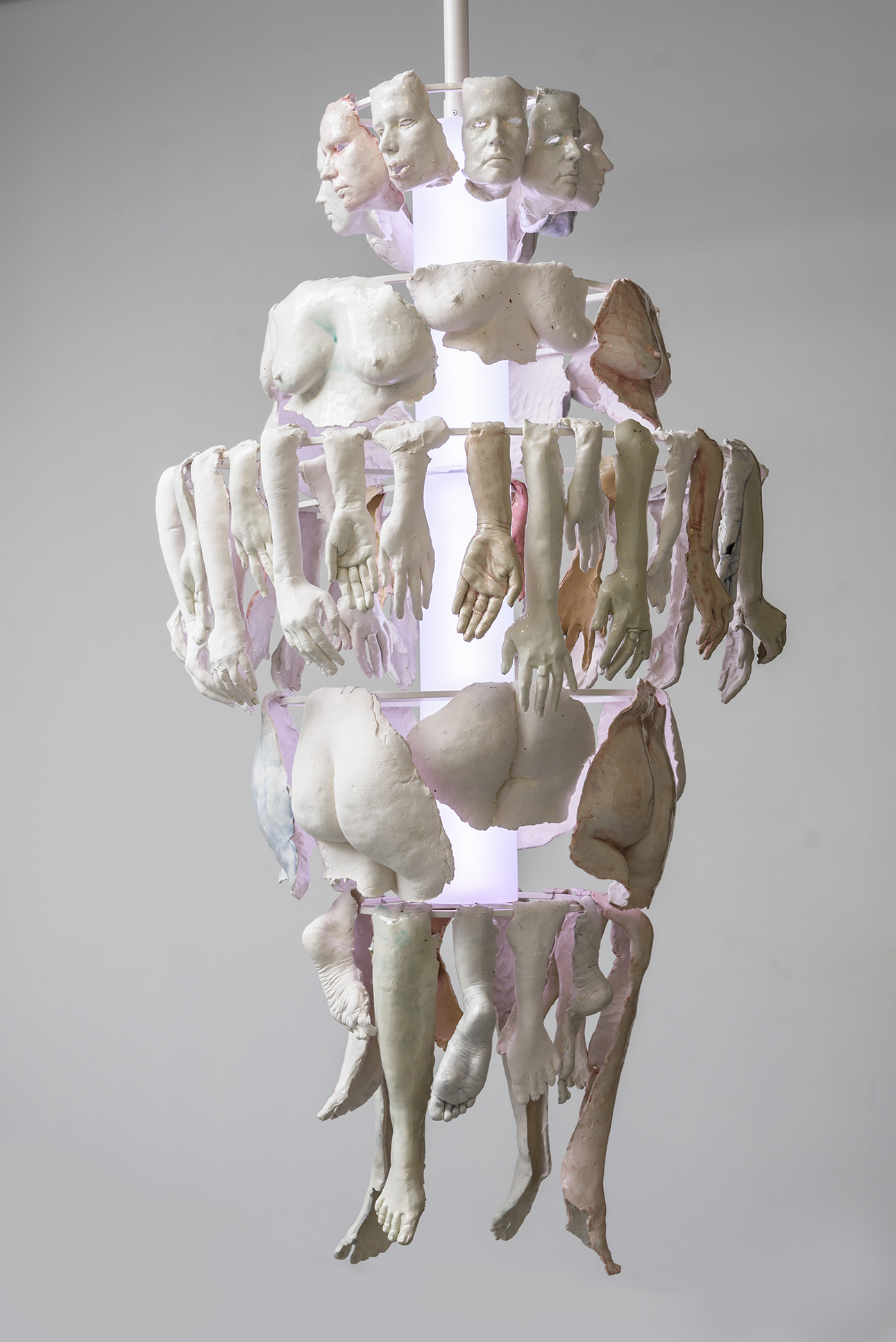
It's 2017. I stand, captivated, in front of a chandelier constructed of moulds taken of a human body, exhibited at a gallery in Tallinn – it’s a work by Edith Karlson, titled Doomsday. The impetus for this work of Karlson's was her experience as a mother. Having gotten almost no sleep during the first three years of her son's life, because he just did not believe in sleeping, the artist took moulds of her body, piece by piece, and combined these battered fragments into a chandelier, thus making as if an inverse calculation. Instead of highlighting idealised and heroized images of motherhood (such as the Madonna and Child motif), she cast light on a worn and exhausted body, expressing through the image of the body that the experience of parenthood can be beautiful but in the same time and space also completely unbearable and destructive.
Sometimes it seems there is no other experience more complex, emotionally difficult, existential, philosophical and ambivalent than parenthood. Parenthood means feeling joy, while being dead tired. Feeling love, while being deeply frustrated. Feeling at peace, while being sad to the core. Feeling hope, while being constantly scared. Simultaneously feeling the utmost pride and the deepest shame. Feeling valued by society but also constantly marginalised. Feeling my child is welcome in society but only on certain terms. Feeling I matter, yet also feeling totally alone. I could continue this list of contradictions forever.
Thirteen years ago, when I became a parent, unexpectedly and at a rather young age, the most difficult thing was the realisation that I could find neither the space nor language to express the feeling of ambivalence within me and surrounding me that becoming a parent incites. There was a positive programme for thinking about parenthood positively (more citizens being born, parenthood being a great joy and privilege, if you only set your mind to it), but there was no positive programme for thinking about parenthood creatively, honestly and in a way that reflects reality.
Inventing my own language
My other child was born ten years later. When it comes to approaches to parenthood, the current situation is immeasurably better and multifaceted. In art, both in Estonia and internationally, in the last five years, the theme has received increasing attention. Sometimes, there have been claims that it has become a trendy topic. Yet, when my second child was born, I was again struck by a resurfacing of the feeling that parenthood, as an experience that connects all of humankind (after all, we have all arrived in this world), something seemingly entirely universal, can at times provoke a state of total loneliness and confusion. These feelings speak to both the contradictions that are bound in the experience of parenthood but also to the society that has shaped and framed these experiences through ideologies, attitudes and power relations but also language and visual culture all around me. On the path towards inventing my own language and understanding all these different experiences, artists and artworks have been such wonderful companions and helped me to accept or not to accept this ambivalence. And also affirmed that we need to speak openly about parenthood, to share experiences and fight against violent and unrealistic expectations.
In different ways, parenthood has been a present theme in Baltic art throughout the 20th and the 21st century, but especially, in the last ten years, it has drawn more attention. It was when I began to notice more and more works addressing the theme of parenthood, nearly five years ago, an idea emerged for a large-scale exhibition at Kumu Art Museum, mapping approaches to the topic specifically in this region. One reason for bringing the Baltic and Eastern and Central European perspective into dialogue was that in the large-scale exhibitions on parenthood that have taken place in the West, this region has not been particularly well represented. Parenthood in Baltic art is certainly not simply a trend, rather, it seems that at present, due to gender-based, feminist and other critical and analytical approaches, a fertile ground has emerged for a multifaceted view of parenthood as a topic that has long been marginalised. In addition, the birth rate debate – that is, politicised discussions about how to get women to give birth more and increase the population – has, across the Baltics, generated resentment and resistance among the younger generation and a sense that it is necessary to offer counter-discourses and to share their own stories. Of course, the four artists I'm writing about here only make up a tiny speck of art addressing themes relating to parenthood. Edith Karlson, Hanna Piksarv, Vika Eksta and Jurga Barilaitė are linked by the fact that at different times they have offered a very subjective view of this broad and complex theme, each of them highlighting the ambivalent feelings contained in parenthood.
Realistic experiences
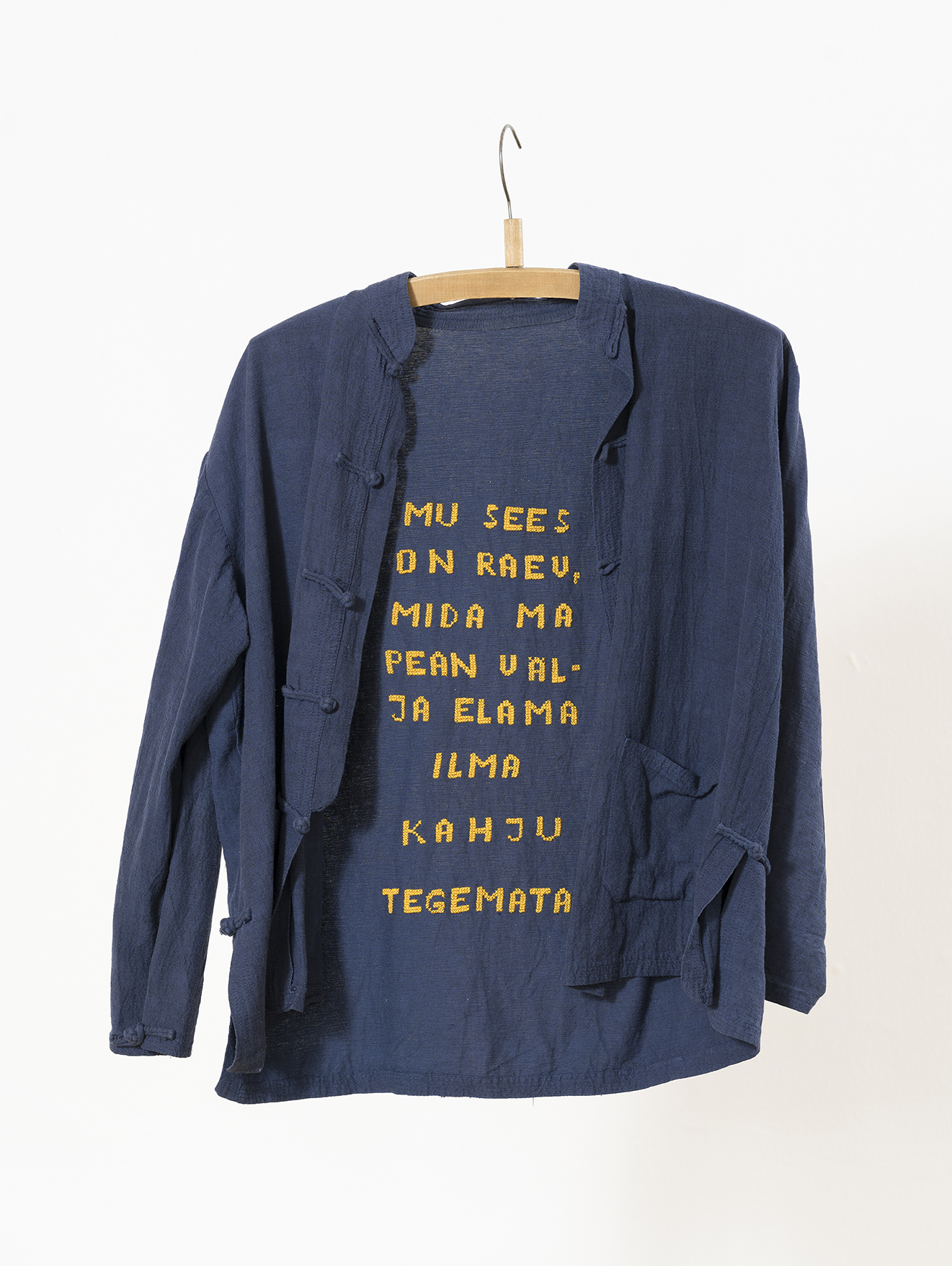
It's spring 2021, in another gallery in Tallinn, I am looking at a dark blue jacket, hanging from a ceiling with the following words embroidered: "There is rage inside me I need to release without hurting anybody." Looking at the label, I see Hanna Piksarv's work is titled Mother Rage (2020). Tears run across my cheeks. This delicate jacket unleashed a whole array of big and heavy feelings in me. Living with children, I have suppressed a lot of different emotions that could hurt them. I have felt that a good mother can never be upset, frustrated or tired. Piksarv's work that sheds light on the parent and their feelings also made me understand that due to internalised expectations, I have pushed down quite a few things within me and left that bundle of contradictory feelings untangled. I have felt guilt that I'm frustrated sometimes but also unable to recognise my own needs, and perhaps shielded the children at my own expense. For Piksarv, it is important to speak about how the "we will manage" attitude can cause a mess of emotions. Mother rage is not mothers' personal problem but caused directly by social pressure and the expectation that a good mother will always manage. And when she doesn't, it's her own fault. That breeds guilt, shame, loneliness and fear, often merging into rage. Piksarv sought support for processing her emotions through embroidery, but while creating the work, with sensitivity and honesty, she stitched a theme into the cultural fabric of Estonian art that had not previously been addressed within the context of parenthood. Parents are often tired and overwhelmed but that does not mean they do not love their children. They need stories that convey realistic experiences, understanding and support.
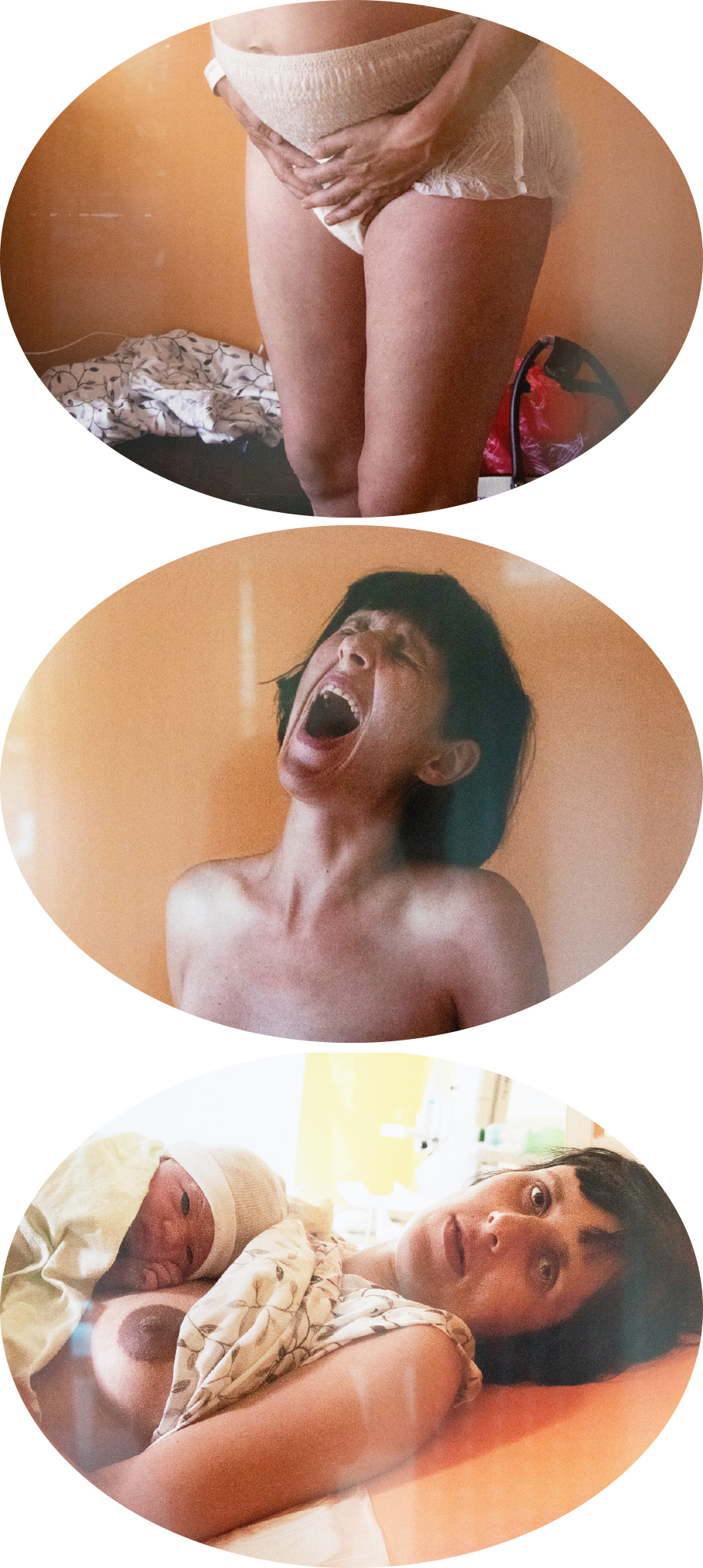
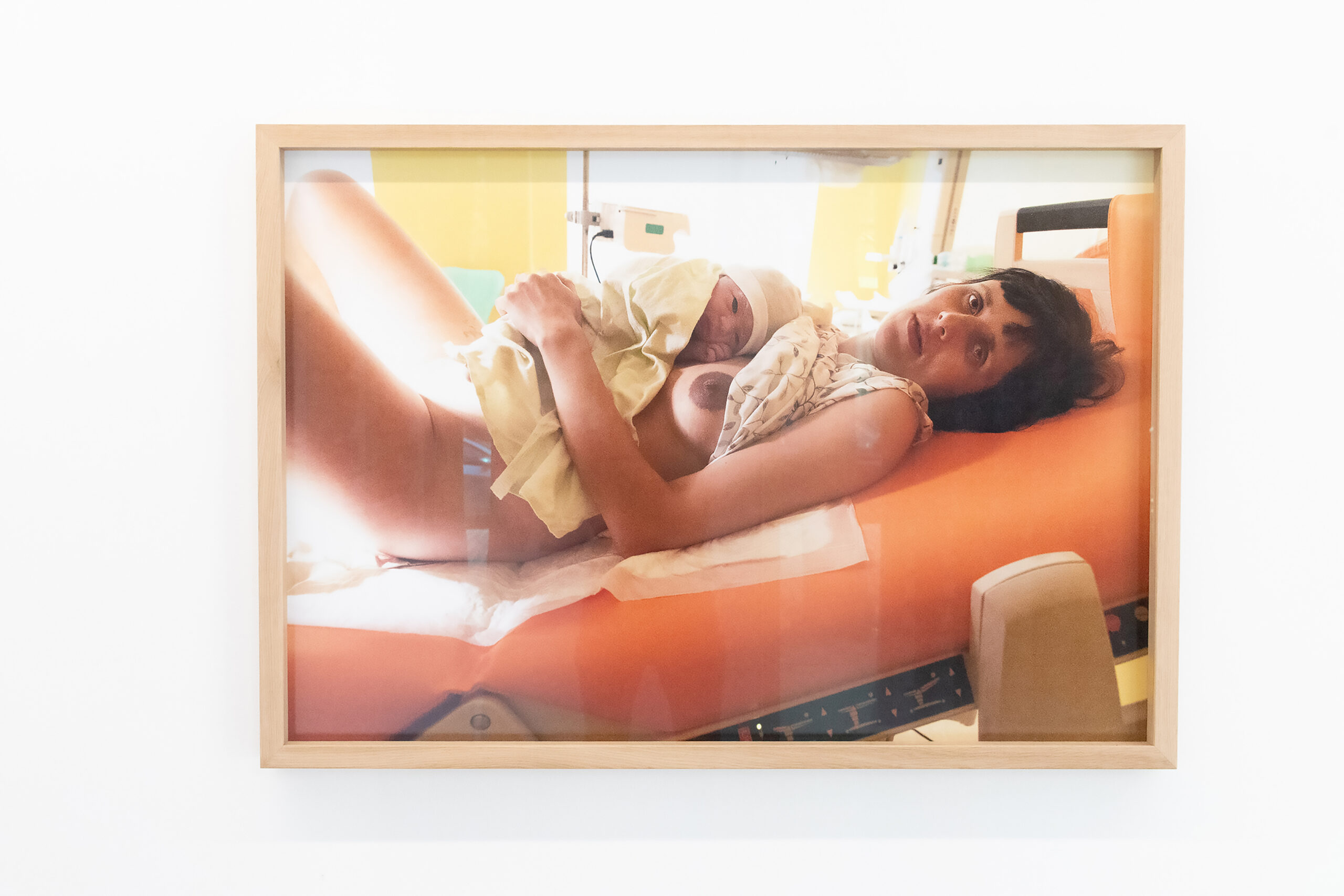
In winter 2024, I'm looking at a computer screen displaying images from a project entitled Encounter (2023) by artist Vika Eksta. Eksta documented the process of childbirth, trying to capture the choreography of pain through her lens. A perspective new to Latvian art. The photographs display blood, pain and raw viscerality testifying to the existential dimension of being, discussed nearly not enough. In childbirth, it is not only a new small human being who's being born, but as Lucy Jones has written in her book Matrescence, through this experience, the woman is also reborn. The impact of this change has only been more widely acknowledged in recent years; that is, increasingly attention is turned to how hormones, the body etc. impacts the woman's brain, psychology and well-being, both during pregnancy and several years after giving birth. At the same time, our culture does not have language and customs to make sense of this transformational time. So, Eksta places her own experience, feelings and sensations as the one giving birth and the one being born at the forefront. This perspective, a kind of a self-portrait, provoked conflicting feelings. There were those who resonated with the honest and raw visual analysis, pointing out that projects that centre on women's experience are very much needed. At the same time, Eksta also received negative feedback from viewers and even accusations that she is using such a deep personal experience for exhibitionist aims. When it comes to childbirth and parenthood, based on the feedback, it seems there's an expectation that the presentation should reflect a blessed state, distilled of fluids and pain.
Marginalised topic
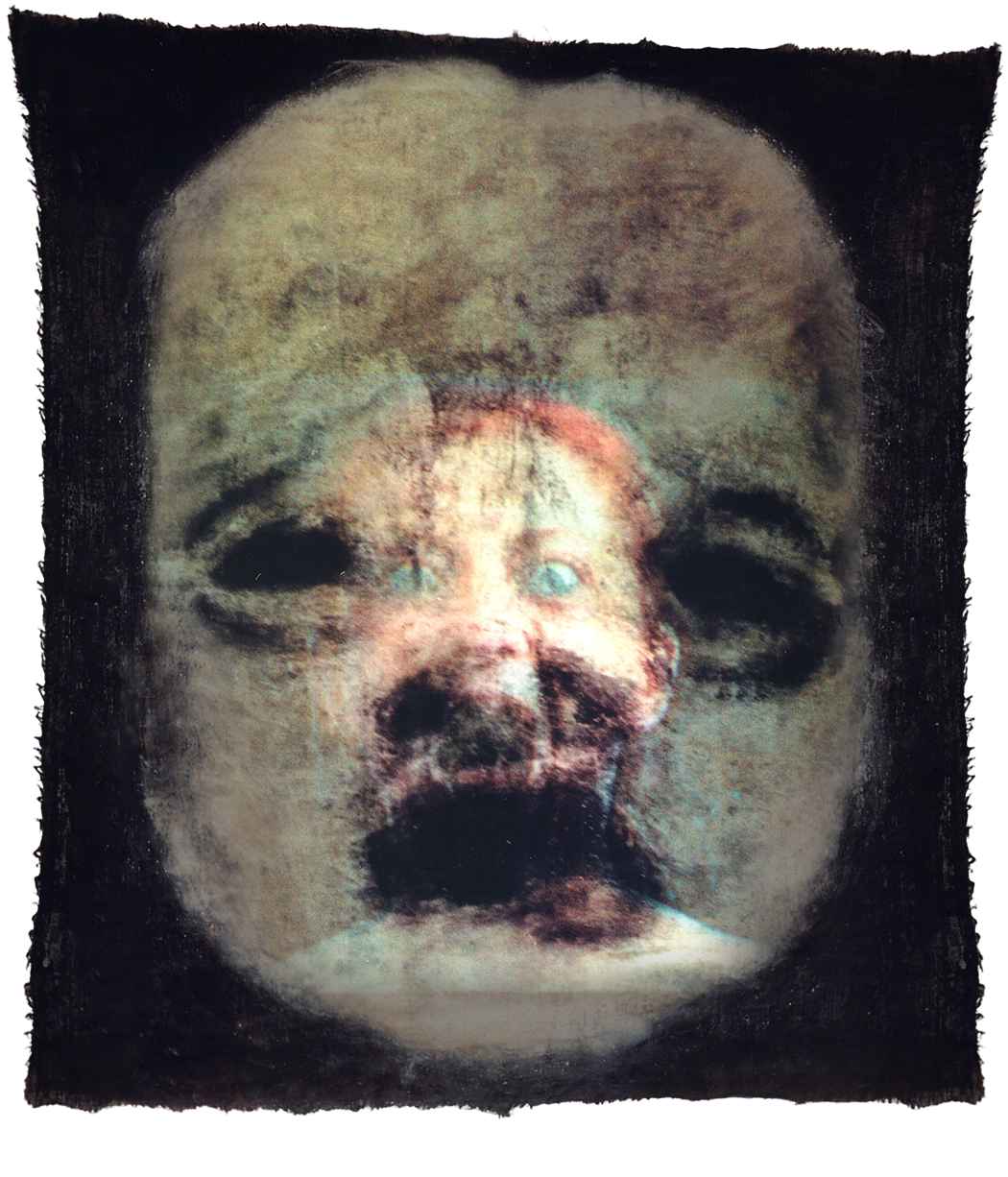
In summer 2025, I sit with artist Jurga Barilaitė in a café in Vilnius and she tells me about her 1999 artwork When You Look At Me – I Scream. The work draws from two sources, both Barilaite's experience as a first-time mother as well as that of a painter in Lithuania in the late 1990s. It's a video and sound installation – on a baby's face painted on a canvas in a slightly disturbing manner, a video is projected, showing Barilaitė's face front on screaming her lungs out. The sound becomes audible as the viewer approaches the work. Through this artistic gesture, the mother and son form a visually contrasting and layered whole and share an Umwelt that deters the outside gaze by screaming. On the one hand, as a young painter, Barilaitė wanted to create a shift in the canon of Lithuanian painting. At the time, integrating video, painting and sound in this way was not too common. Additionally, in the Lithuanian field of contemporary art of the late 1990s, referencing motherhood was a bold gesture, as the topic was rather marginalised; that is, underappreciated next to "serious" issues. Barilaitė depicts her son in a large-format painting, hinting at the challenge of being a parent and a young artist. Through her existential scream, Barilaitė expresses her frustration at the occasional incompatibility of these different roles (mother and artist), while also pushing away with her whole body those who intrude into the relationship between herself and her child and provoking this ambivalent feeling.
In the context of all the aforementioned works, which highlight the ambivalence of the experience of parenthood, we could speak of a politics of affect. Emotions and their expressions have, among other things, an empathetic, community-building and comforting potential; that is, a potential that values personal experience and, through it, shifts social norms, expectations and assumptions. The artists seem unwilling to accept the assumption that mothers must be self-sacrificing to the very end and therefore masochistic, they do not normalise the pain, anxiety and suffering associated with parenthood but instead take a step further, opening up new ways of understanding and interpreting parenthood through their personal stories.