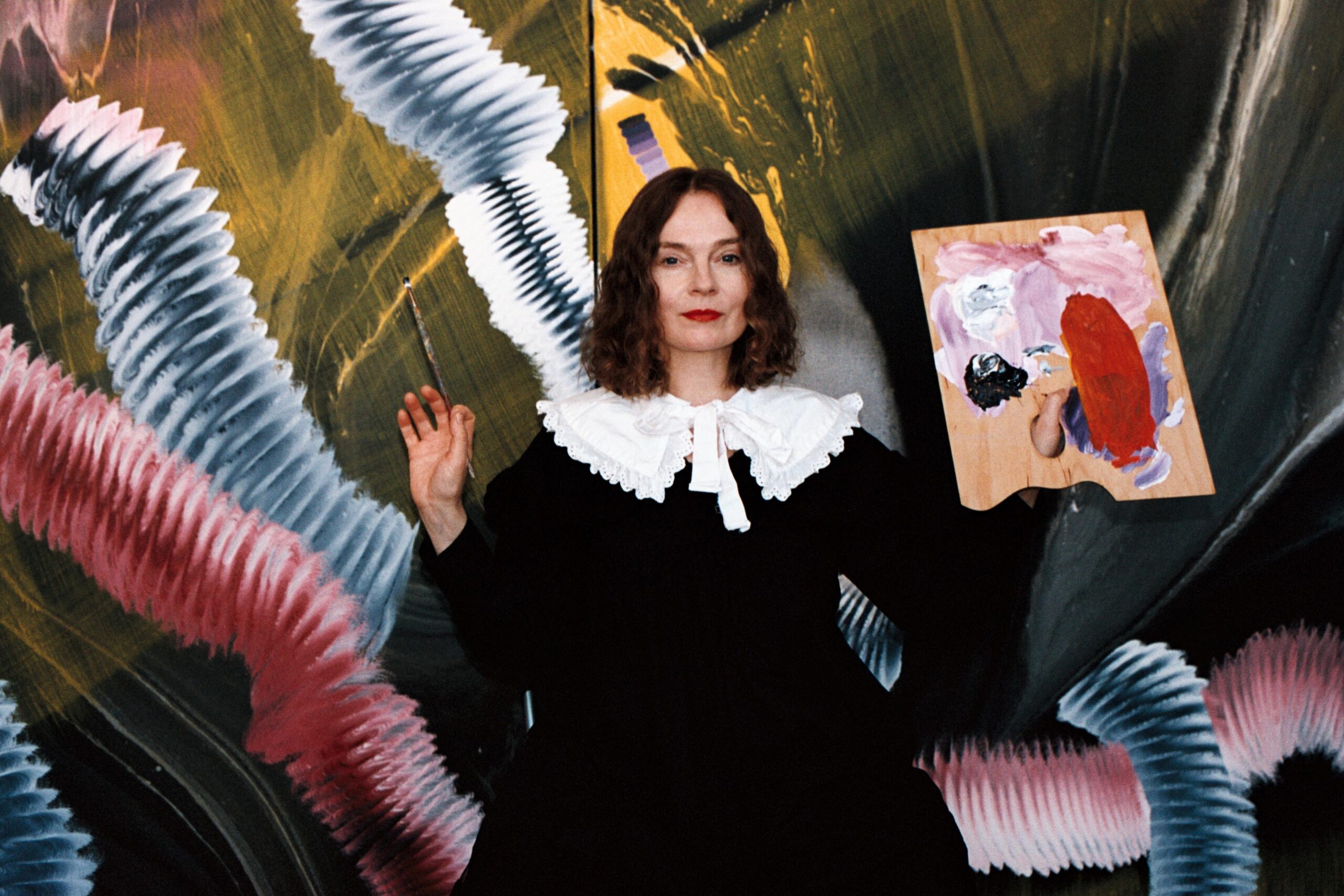
Merike Estna in the garden of her studio with her children, Kõu and Lumi. 9 August 2025, Mexico City, Mexico. Photo: Aime Estna
With her large scale, hybrid and immersive painterly installations, artist Merike Estna brings a playful, joyful and ever so critical and expansive perspective to what painting is and can be today. She combines traditional craft techniques with a bright colourful pallet and painterly gestures, uses textiles (from curtains to clothing and carpets), floral and other decorative patterns, and often references folk stories and myths.
As I was working on the exhibition Good Mom/Bad Mom; Unravelling the Mother Myth at the Centraal Museum (together with Heske ten Cate) I got to know Estna’s work through the shared interest in the complicated relationship of motherhood to art history.
What strikes me in the work of Estna is how she so easily manages to collapse traditional hierarchies of high and low culture, fine art and craft, abstraction and ornament. And yes, motherhood fits right into that sequence of craft and ornament as equally gendered and marginalised.
It’s February 2026 and Merike and I meet in the evening for a digital interview. Me in Amsterdam, Merike in Tallinn, where she has temporarily moved back to from Mexico City so she can work on The House of Leaking Sky, her exhibition for the Estonian Pavilion at this year’s Venice Biennial.
Laurie Cluitmans: The first time we met was also a digital meeting and I remember you had only just given birth but were up and running, business as usual. That was very impressive.
Merike Estna: Well, yes, these two things arrived together in my life. I was selected for Venice and that very same week I found out I was going to have my second baby. So, these two have been hand in hand from the beginning.
LC: Like a package deal. I would love to talk about the labour of love and the labour of painting. But first maybe we start at the beginning. Or a beginning. Was art something that you grew up with?
ME: Well, my parents are both photographers. When I grew up Estonia was still part of the Soviet Union and my parents focused on documentary photography. They took us to see exhibitions and we would go to the theatre and opera a lot. I think that was more common in Soviet times, perhaps because of a lack of other entertainment options.
LC: I read that besides studying painting at the Estonian Academy of Arts in Tallinn and Goldsmiths in London you participated in the Academia Non Grata in Pärnu, Estonia?
ME: Yes, it was an alternative art school, focused on performance and live action art. We studied through making things together. The group would visit different festivals and if somebody had an idea, we would be executing it together. It had an 80s style existentialist attitude and was very body-based. Always looking at the body as a tool. Actually, I have never really talked about it much but it was really important in my development. That year at Academia Non Grata really opened my mind to what art education can be, but also how things can be different than the expected, than what society expects of you or how it expects you to behave. You know you can run naked through the city and still be okay.
Merike Estna, Ghost of the future, filled with memories of past, Exhibition view with performative presence. Moderna Museet Malmö, 2019. Photo: Helene Toresdotter
LC: Is this when you started seeing yourself more as a painter in this expanded field that you work in?
ME: Well after this I went to study painting at the Estonian Art Academy, where I later joined a master's course run by Jaan Toomik, who's one of the old masters of the Estonian art scene, and his class was very interdisciplinary. His programme included a lot of performance and was very action based. And then at Goldsmiths College in London I was questioning painting and all those opinions of all the professors all the time. I wanted to challenge the painting as a 2-dimensional object and I wanted to use everything that I was taught not to use. It made me desire to look at painting as something that is part of life and alive itself, instead of some precious object. Ever since, I like to challenge this medium.
LC: Where did this desire to make painting more part of life come from?
ME: For me it’s important that a painting can talk about the moment we live in, even if there’s disbelief that a painting can do such a thing. That’s why I often create these big installations as a way for the artwork to stay open. There’s no singular point from which to view the work, for example. There are endless options on how to see and experience the work as you walk through it, or when you actually step on top of it. It doesn’t have a singular answer. When I begin with a work I usually start with a concept and let it develop spontaneously from there. I see the total installation as the painting and the individual paintings like brushstrokes.
LC: How did the installation for the Venice pavilion develop?
ME: For a long time, I have been trying to achieve this living painting and I’ve tested all these different ways. Floor paintings, a stage painting on tiles, painting on glass, or as robes to wear or cakes to eat. And then I realised that actually for me, a painting is most alive when it is still being born, when it doesn't have a fixed end nor a fixed position. So the task I set for myself is that I will be making a painting during the biennial and it should be finished by the end of it.
Floor tiles for The House of the Leaking Sky. 2026. Scans of hand painted ceramic 9.6 x 9.6 cm
Merike Estna. Photo: Marta Vaarik
LC: What role does the performative play in this durational gesture? Would you consider this a performance? Or a performance of the self as artist?
ME: How I work and how long each day might be is up to the painting, depending on how it goes and I don't think I can control that because I'm not aiming to perform the painting but to really make the painting. And there will be a performative element to it. I want to highlight me being a female painter on this world stage. So, I'm going to wear a performative costume. It’s a selection of fine dresses, designed by Estonian designer Lilli Jahilo. I started this project with many historic references that will also become part of the dress. For example, portraits of Lavinia Fontana (1552–1614) and Marietta Robusti Tintoretta (1560–1590) and a sketch of a nursing woman, inspired by a painting by Paula Modersohn Becher (1867–1907). All three are very important for the project. Lavinia was one of the first European female painters who made a professional career out of it. She ran her own workshop and supported her family. She gave birth to eleven children and at the same time supported her family. Tintoretta for me is an example of a female painter without her own works, as paintings were often not signed by women artists. And then Modersohn-Becher is very important for me as she is one of the first painters who depicted motherhood scenes and nursing women.
LC: Three women artists whose story goes against the regular narrative of art history where woman and the labour of motherhood has been considered less interesting, not a subject matter for great art. Lavinia really teaches us that the age-old cliché that as a female artist you should choose between being an artist and being a mother is just a myth. How do you see your relationship to these three historical characters?
ME: I see them as really important figures who each opened some doors for all of us coming after. And what I paint is definitely influenced by this history. I have this huge canvas, 22 metres long and six metres high. A rebellion of course against the masculine history of really big paintings. The pavilion will consist of two large pieces – one is this long canvas that I will paint during the biennial and the second is a floor piece made out of painted tiles and installed using a very long bench reaching across the long painting. I’m working on this floor piece now together with many assistants, who themselves are amazing artists. Together with curator Natalia Sielewicz and architect Diogo Passarinho I’ve worked on the lay out of the pavilion.
The floor piece will already be installed and remain alive as I will be painting on top of it, so paint will leak and drip, and of course people will be walking over it so it will gain more layers and markings during the process.
Merike Estna. Love. 2023. Acrylic, oil on canvas.
Merike Estna, Wild strawberries, 2023
LC: The Estonian Pavilion is always in a new location, what kind of space did you and Natalie find?
ME: The pavilion is a 5-minute walk from the Giardini and it’s quite a surprising space. It’s in a former church that you enter via another building and through a huge courtyard. The courtyard and (in wintertime) the church are both used by a children's after school community centre, which means that it’s this lively space where kids come to play basketball or table tennis. You can see these different and sometimes clashing layers of memories and activities in the church’ interior, the profane and holy meet. And that matched very well with how I work. I started developing this idea of painting as a floor or painting as a stage thinking of historic references of paintings on ceilings as you have in churches. So to now exhibit my work in this type of space is great.
LC: I was wondering if and how your own motherhood has changed or affected your practice?
ME: It was really when I became a mother that I started looking into these female painters and artists in art history. These amazing people who have managed to combine their work with care giving. But I also became really interested in how motherhood has historically been tied to death and mourning as well. People lost their own moms when they were born, lost their own child while giving birth or as young children. So motherhood brings out these existential questions. And actually, I also realised that maybe this whole idea of showing the process rather than just a result has been influenced by motherhood, which really has brought me to appreciate each moment and the process.
For me motherhood has been really good creatively. I know people have very different experiences and that it can be quite traumatic, but for me it has given me a sense of calm energy. I’m not bothered by all sorts of problems that arise with production and I feel that combining family and work is manageable, even though the general opinion of the art world told me it wasn’t. And I do believe that in life there can be many things that can form an obstacle to making art, or the opposite, that can be good for making art, and I want to be realistic about this. Motherhood is just one of those experiences. So I don't think it should be already assumed that this is automatically going to be difficult for creative women.
Merike Estna in her studio with her children, Kõu and Lumi. 9 August 2025, Mexico City, Mexico. Photo: Aime Estna
Merike Estna in the garden of her studio with her newborn baby, Lumi. 9 August 2025, Mexico City, Mexico. Photo: Aime Estna
Merike Estna, Woman with white hair who always takes care, 2023
LC: Thanks to the work of certain groups of artists and writers, like Hettie Judah, a lot of awareness has been raised on the prejudices and financial burdens that mother-artists or mothering artists carry. In the Netherlands, for example, the Mondriaan Fund has created more support structures for artists with children who aren’t in school yet. I was wondering if there’s similar structures in Estonia?
ME: No not specifically but I think the situation here is very exceptional. Kindergarten is affordable, which makes a huge difference and there’s 1.5 years of paid parental leave which can be taken by either of the parents. And on top of that, in general it’s quite friendly towards young children.
LC: You have often worked with myths and folklore. Will they return now in Venice too?
ME: Together with curator Natalia Sielewicz we visited the literature museum in Tartu and found this very interesting Runo song about world making. It’s this beautiful story about women raking the sea and from this work, the world is born. It’s an intriguing story, and afterwards, I created an image of pregnant stick figures, which Kaarin Kivirähk from the pavilion team called an army of prehistoric pregnant women. I like that idea. But there will be other references too; for example, a pattern that I saw in a traditional Estonian wedding rug.
LC: What kind of depiction does the wedding rug have? Is it an abstract or figurative pattern?
ME: It has all these little figures. And actually, though my work has abstract gestures I never think of myself as working with abstraction or referencing abstract expressionism. The patterns in my work reference different decorative techniques, sponging and marbling. I’m interested in where these techniques come from and what their history says.
LC: And are you making sketches for the big wall painting already?
ME: All these different stories and experiences start to end up in the sketches. But of course, I don’t want to sketch it too precisely because then I will end up just executing it and the painting will no longer be alive. For me it’s the most alive when the idea is also being created.